
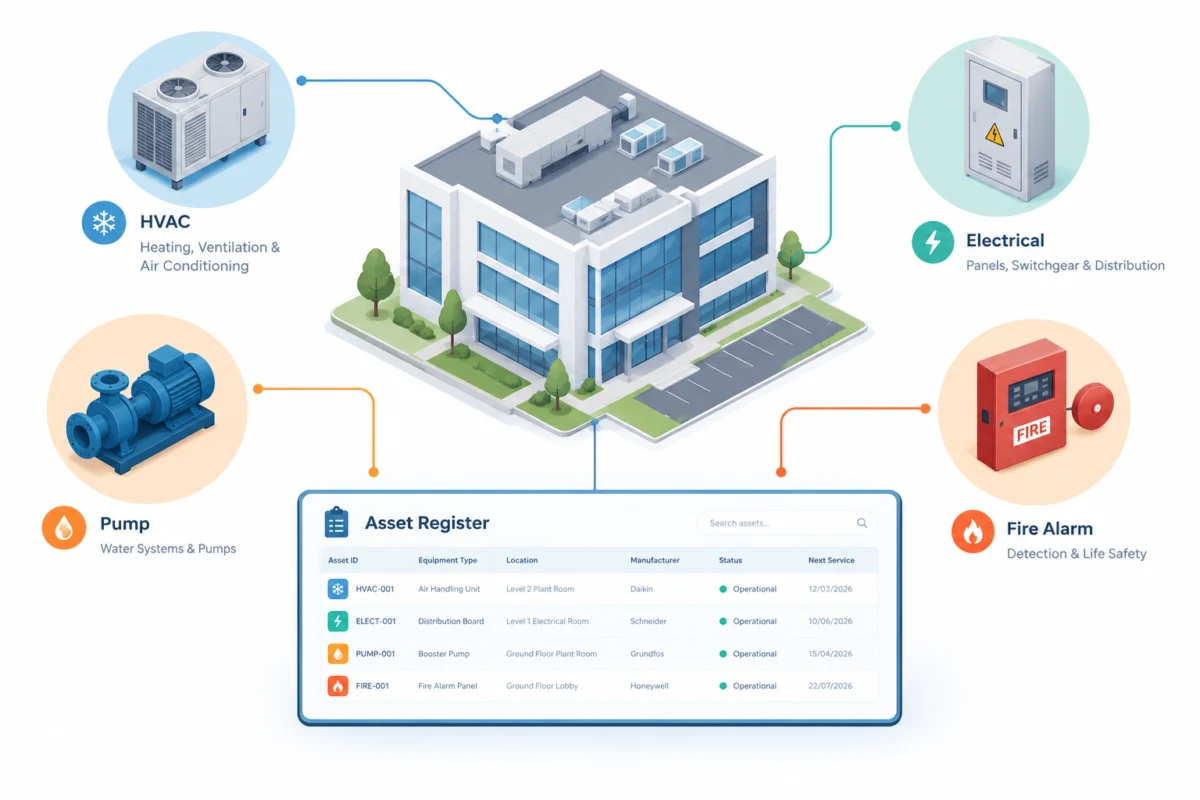
A clear record of the equipment in a building, the details that identify it and the information that supports its use.
An asset register is a structured list of assets and their identifying information. Businesses use registers for different purposes, including equipment records and financial accounting. For building handover, the focus is usually the installed equipment that the receiving team needs to identify, locate and maintain.
A building asset register may record air handling units, pumps, distribution boards and other agreed equipment. It brings the required details into one organised place, with references to supporting documents where available. The contents depend on the project specification, client template and information supplied.
At a glance
A building equipment register helps answer three questions: what is installed, where is it and where can the supporting information be found?
For the wider principles behind managing assets throughout their life, see the ISO 55000 overview.
What is a building asset register used for?
A register gives contractors, building owners and facilities teams a consistent reference for the equipment included in its scope. Rather than searching through separate schedules and manuals to identify an item, the team can start with its register entry.
It can help the receiving team:
- Identify equipment using an agreed asset reference.
- Find its recorded building, floor, room or plant location.
- Locate available manufacturer and model information.
- Connect the entry to relevant drawings, manuals or warranty records.
- See which details still need confirmation.
A technical equipment register has a different purpose from a financial fixed asset register, which may record costs, depreciation and accounting information. Some organisations link these records, but their fields and review requirements should be agreed separately.
Which fields should an asset register include?
The required fields should be confirmed before information is collected. For a building equipment register, useful examples include:
| Field | What it records |
|---|---|
| Asset reference | A consistent identifier for the equipment. |
| Description and system | What the item is and which system it belongs to. |
| Location | Building, floor, room or plant area, as applicable. |
| Manufacturer and model | Identifying details from the supplied records. |
| Serial number | The individual equipment number, where available. |
| Duty or rating | Relevant technical information required by the specification. |
| Supporting references | Relevant O&M sections, drawings, commissioning or warranty records. |
Condition, maintenance history and replacement information may also be useful where they fall within the agreed scope and are supported by suitable records. Missing details should be flagged for confirmation rather than guessed.

A practical example: an air handling unit
Consider an air handling unit identified as AHU-01. Its entry can connect the asset reference with its recorded location, manufacturer details and the relevant O&M information. The same reference should be used consistently in the supporting documents.
Illustrative entry, not a client record
Asset: AHU-01
Description: Air handling unit
Location: Roof plant area
Manufacturer / model / serial: Populate from verified project records
Supporting reference: Relevant mechanical O&M section
The entry identifies the information to bring together. It does not establish equipment condition or confirm that servicing has been completed.

Illustrative equipment-identification scene, not a photograph of a Master Manuals site survey.
Is an asset register the same as an O&M manual?
No. The register provides a structured equipment list. An O&M manual contains the more detailed operating and maintenance information for the installed systems and equipment.
The two records work well together when asset references are consistent. A register entry can direct the reader to the relevant manual section, rather than repeating all the instructions in the register itself.
Preparing records is also distinct from ongoing asset management. Inspections, servicing, condition assessments and replacement decisions remain separate activities with their own responsibilities.
How is a building asset register prepared?
- Agree the scope. Confirm which equipment is included, the required fields and the client’s preferred template.
- Collect the source information. Gather available equipment schedules, drawings, manufacturer details and supporting handover records.
- Compile and check. Use consistent references and descriptions, and identify duplicate entries, gaps or conflicting details for clarification.
- Review and issue. Incorporate agreed comments and confirm who will maintain the record after handover.
A spreadsheet can be suitable where it meets the client’s requirements. Specialist systems may be used for larger portfolios or additional functions. The format should suit the people who will use and update the information; a register does not have to be a software platform.
Where physical verification is needed, the project team should agree who is responsible for it. Compilation from supplied documents should not be assumed to include a site survey or equipment inspection.
For the detailed workflow, read our guide on how to prepare a building asset register.
Who updates the register, and when?
The building owner or responsible management team should assign ownership of the record. Relevant updates may be needed when equipment is replaced, moved, removed or otherwise changed, or when missing identifying details are confirmed.
Routine review intervals should reflect the organisation’s arrangements, the equipment and how the information is used. There is no single review frequency suitable for every register.
Keep earlier versions or change records where appropriate, and make the current issue easy to identify. A clear register supports access to information; it does not replace inspections, maintenance instructions or evidence that work has been completed.
How Master Manuals can help
Master Manuals prepares project-specific building asset registers using information supplied by the project team. We organise the agreed equipment details and document references into a structured handover record.
The scope, fields and output format are confirmed around your requirements. Gaps or conflicting information are identified for the project team to resolve. Explore our Asset Register preparation service for more information.
Frequently asked questions
What equipment should be included?
The equipment scope should follow the project specification and client requirements. Examples may include pumps, air handling units, distribution boards and other agreed mechanical and electrical equipment.
Can an asset register be prepared in Excel?
Yes, where Excel meets the client’s requirements. The template, fields and final format should be agreed before preparation begins.
What if serial numbers or other details are missing?
Record the gap and ask the responsible project party to confirm the information. Do not invent details or assume that one item’s data applies to another.
Does an asset register prove equipment has been maintained?
No. The register can reference maintenance information, but evidence of completed work comes from the relevant inspection, servicing or other supporting records.
Need equipment records organised for handover?
Share your required template, equipment scope, available records and handover date so we can review the preparation requirements.