
Preparing an accurate and complete Operations and Maintenance (O&M) manual is an essential part of project handover. For UK contractors, an O&M manual provides the client and future building operators with the information they need to understand, operate, maintain and repair installed systems and equipment.
However, compiling an O&M manual can become challenging when project information is spread across different teams, suppliers, manufacturers and subcontractors.
So, what information is actually required?
This practical O&M manual checklist explains the key documents and information contractors should collect during a project, helping make O&M manual preparation more organised and reducing the risk of missing information at handover.
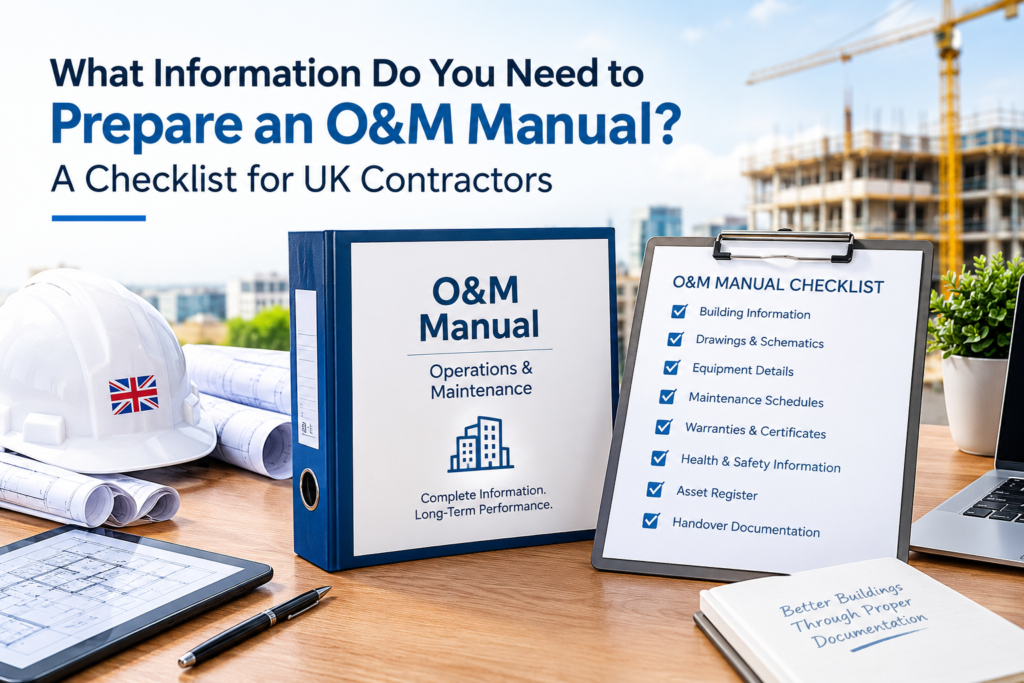
1. What Is an O&M Manual?
An O&M manual is a structured collection of documents and information relating to the operation and maintenance of a completed building, system or installation.
It normally brings together information such as equipment details, manufacturer instructions, maintenance schedules, test certificates, warranties, drawings and commissioning records.
The completed manual gives the building owner, facilities management team and maintenance contractors a reliable reference for operating the installed systems throughout their lifecycle.
A good O&M manual should be clear, logically organised and easy to navigate. It should also reflect what has actually been installed on the project rather than simply containing generic product information.
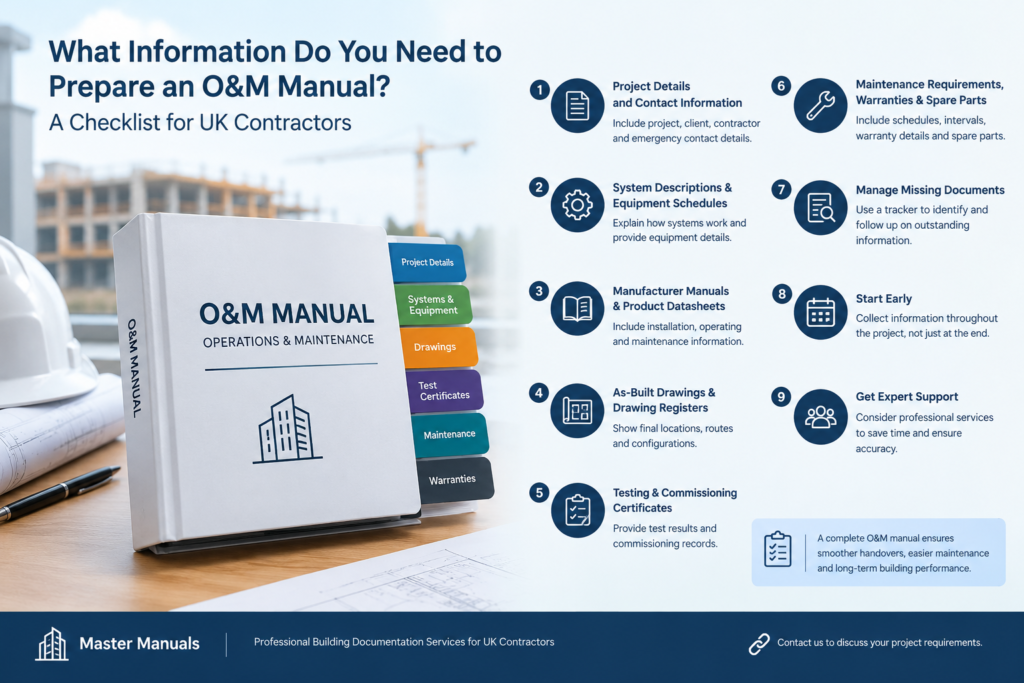
2. Project Details and Contact Information
The first section of an O&M manual should establish the basic project information.
This may include:
- Project name and address
- Client details
- Main contractor information
- Principal contractor and relevant subcontractors
- Consultant and design team details
- Facilities management contact information
- Project completion or handover date
- Relevant emergency contact details
Keeping this information together makes it easier for the client or facilities team to identify who was responsible for different elements of the project and who to contact when support is required.
For relevant construction health and safety information, contractors can consult the HSE’s official construction guidance.
3. System Descriptions and Equipment Schedules
The O&M manual should explain the systems installed within the building and provide enough information for someone to understand how they operate.
Depending on the project, this could include mechanical, electrical, plumbing, fire protection, HVAC, controls, security or other building services.
Equipment schedules are particularly useful. They can provide details such as:
- Equipment type
- Manufacturer
- Model number
- Serial number
- Location
- Capacity or specification
- Associated system
- Relevant maintenance information
A clear equipment schedule can save significant time when maintenance teams need to identify a particular item of equipment.
4. Manufacturer Manuals and Product Datasheets
Manufacturer information is another important part of the O&M manual requirements.
Contractors should collect the latest relevant manufacturer documentation for the products and equipment installed on the project.
This may include:
- Installation instructions
- Operating instructions
- Maintenance manuals
- Product datasheets
- Technical specifications
- Troubleshooting information
- Cleaning instructions
- Replacement component information
One common problem during O&M manual preparation is receiving generic manufacturer literature that does not clearly relate to the equipment actually installed.
Where possible, documentation should be checked against the final equipment schedules and installation records before inclusion.
5. As-Built Drawings and Drawing Registers
As-built drawings provide an important record of the completed installation.
The O&M manual may need to include relevant drawings showing the final locations, routes and configurations of systems and equipment.
These could include:
- Mechanical drawings
- Electrical drawings
- Plumbing drawings
- Fire protection drawings
- HVAC drawings
- Controls and BMS drawings
- Architectural drawings where relevant
A drawing register should also be maintained so that users can quickly identify each drawing, its reference number, revision and description.
The key point is that the drawings should reflect the installation as completed, including relevant changes made during construction.
6. Testing and Commissioning Certificates
Testing and commissioning records demonstrate that systems and equipment have been tested and, where applicable, commissioned in accordance with the project requirements.
Depending on the scope, documentation may include:
- Commissioning certificates
- Test results
- Inspection records
- Electrical test certificates
- Air and water balancing reports
- Fire alarm testing records
- Emergency lighting test records
- Pressure test certificates
- Equipment commissioning sheets
These records provide useful evidence for the client and facilities management team and can also support future maintenance and troubleshooting.
Contractors should avoid leaving the collection of these documents until the final stages of the project. Certificates can be difficult to locate once subcontractors have left site.
7. Maintenance Requirements, Warranties and Spare Parts
An effective O&M manual should tell the building operator what needs to be maintained and when.
Maintenance information may include:
- Routine maintenance schedules
- Recommended inspection intervals
- Cleaning requirements
- Servicing instructions
- Replacement intervals
- Consumable requirements
- Recommended spare parts
- Warranty information
- Supplier contact details
Warranty documentation is particularly important at handover. The manual should make it clear which equipment is covered, the warranty period and any conditions that could affect warranty validity.
Including recommended spare parts can also help facilities teams plan future maintenance and minimise unnecessary downtime.
8. How to Identify and Manage Missing Documents
One of the biggest challenges in O&M manual preparation is incomplete documentation.
An O&M manual checklist can help the project team monitor outstanding documents and confirm that all required information has been collected.
A practical way to manage this is to create a document tracker or information schedule. Each required document can be listed with a status such as:
- Received
- Awaiting subcontractor
- Awaiting manufacturer
- Under review
- Requires correction
- Not applicable
- Approved
For example, if an air-handling unit manual is missing, the tracker should identify who is responsible for supplying it and when it is expected.
This approach gives the project team visibility of outstanding information instead of discovering missing documents immediately before handover.
9. When Should You Start Collecting Information?
The best time to start collecting O&M information is during the project, not at the end.
Waiting until practical completion can create unnecessary pressure because subcontractors may have already demobilised and project teams may be focused on closing other outstanding items.
A better approach is to collect information progressively.
At procurement stage, identify the required manufacturer documents. During installation, record equipment details and changes. During testing and commissioning, collect certificates and reports. Before handover, review everything against the project requirements.
This makes the final O&M manual preparation process much more manageable.
Reviewing the O&M manual checklist throughout the project helps reduce last-minute document gaps and handover delays.
10. How Master Manuals Supports Document Collation and Preparation
Collecting and organising O&M information can be time-consuming, particularly on projects involving multiple subcontractors, suppliers and building systems.
Master Manuals can support contractors with the collation, organisation and preparation of project documentation, helping turn scattered project information into structured and professional O&M manuals.
The process can include reviewing the available information, identifying gaps, organising documents into a logical structure and preparing the final manual for handover.
This can help project teams reduce the administrative workload while providing clients with documentation that is easier to navigate and use.
Find out more about our Building Manuals service. If you need help turning these records into a project-specific manual, explore our O&M manual writing services.
Practical O&M Manual Checklist
Use this O&M manual checklist to review the essential documents and information required before submitting the manual for handover.
- Project and contact information
- System descriptions
- Equipment schedules
- Manufacturer manuals
- Product datasheets
- As-built drawings
- Drawing register
- Testing and commissioning certificates
- Maintenance schedules
- Warranty information
- Spare parts information
- Supplier and subcontractor details
- Relevant inspection and test records
- Outstanding document tracker
- Final document review and approval
Anonymised Example
Consider a UK commercial refurbishment project involving HVAC, electrical and fire alarm installations.
At handover, the contractor has most of the project information but discovers that several equipment manuals and commissioning certificates have not been provided by subcontractors. Instead of delaying the entire handover, the project team can use a document tracker to identify exactly what is missing, assign responsibility and follow up with the relevant suppliers.
Once the outstanding documents are received, they can be checked, correctly named, organised and incorporated into the final O&M manual.
This simple process can make the difference between a fragmented handover pack and a professional, usable O&M manual.
Start Your O&M Manual Preparation Early
A successful O&M manual depends on accurate information being collected throughout the project. By using a structured O&M manual checklist, contractors can identify required documents early, track missing information and reduce last-minute problems at handover.
From project details and equipment schedules to manufacturer literature, as-built drawings, testing records, warranties and maintenance information, every document has a role in creating a useful handover manual.
Need help preparing your project’s O&M manuals? Contact Master Manuals to discuss your scope, available documentation and handover deadline.
What is the main purpose of an O&M manual in UK construction?
An O&M (Operations & Maintenance) manual serves as a comprehensive guide for the building owner and facilities management team. It contains essential details on how to safely operate, maintain, service, and repair all installed systems and equipment throughout the building’s lifecycle.
What should an O&M manual contain?
An O&M manual should contain the key information needed to operate and maintain a completed building or system. This typically includes project details, system descriptions, equipment schedules, manufacturer manuals, product datasheets, as-built drawings, testing and commissioning certificates, maintenance requirements, warranties, and spare parts information.
Who is responsible for preparing an O&M manual?
Responsibility can vary depending on the project and contract requirements. Contractors, subcontractors, and suppliers are generally responsible for providing relevant information for their work packages, while the main contractor or an appointed O&M specialist may coordinate, review, and compile the final manuals.
Who is responsible for providing the O&M manual at project handover?
The Principal Contractor (or Main Contractor) is primarily responsible for compiling, organizing, and delivering the complete O&M manual to the client prior to practical completion and handover.
Can Master Manuals help format and organize O&M manuals for UK contractors?
Yes. Master Manuals supports contractors by auditing available project documentation, identifying missing records, standardizing document formats, and assembling clear, professional, and compliant O&M handover packs.