

Construction document management is the process of organising, reviewing, issuing and retaining project information. The aim is simple: help the right people find the right record and understand whether it is suitable for the task in hand.
Drawings, equipment information and commissioning records may be produced by different organisations. Agreeing how these files are identified and checked during the project makes the final handover easier to coordinate.
During construction
Track revisions, review comments and issue status so teams understand which information they should use.
At handover
Bring together the agreed final records, identify outstanding items and make the information easy for the receiving team to navigate.
Agree the information requirements first
For general principles of creating, capturing and managing records, see the ISO 15489-1 overview.
Confirm the required documents, formats, naming convention and review responsibilities with the project team. Identify who supplies each record, who checks it and when it is due. Requirements should reflect the contract and agreed project arrangements; a generic folder list is not a substitute for that agreement.
Where source records are only available on paper, our guide to construction document scanning explains capture quality, file identification and checks before digital records are filed.
Use a clear folder structure and file names
Group information by the agreed discipline, system or document type. Use consistent document references and descriptive titles. Keep the document number, revision and status visible in the register, rather than relying on file names such as “final” or “latest”.
For example, an illustrative file name might be PRJ-MECH-AHU01-OI-P02.pdf. Its meaning must be defined by the project convention. This example is not a prescribed naming standard.
Maintain a document register
A register gives the team a practical way to monitor submissions and outstanding actions. The following fields are a starting point, rather than a mandatory template.
| Field | What to record |
|---|---|
| Document reference and title | A unique identifier and a clear description. |
| Originator and responsible reviewer | Who supplies the information and who reviews it. |
| Revision and status | The version and its permitted purpose under the project arrangements. |
| Issue and review dates | When the record was submitted and when a response is due. |
| Comments and outstanding actions | What needs resolving, by whom and by when. |
Keep review, approval and issue status distinct
Receiving a file does not mean that it has been checked or approved. Record the outcome of the agreed review and make unresolved comments visible. A document issued for review should not be assumed suitable for construction or final handover.
Keep superseded revisions identifiable and separate from the current issue. Retain the necessary history under the project’s retention arrangements, while reducing the risk that an older copy is used by mistake.

Control access and preserve the record
Use the agreed shared location or information platform, with access appropriate to each person’s role. Follow the organisation’s arrangements for backups, retention and sensitive information. Check that links and file permissions still work when information is transferred to the client.
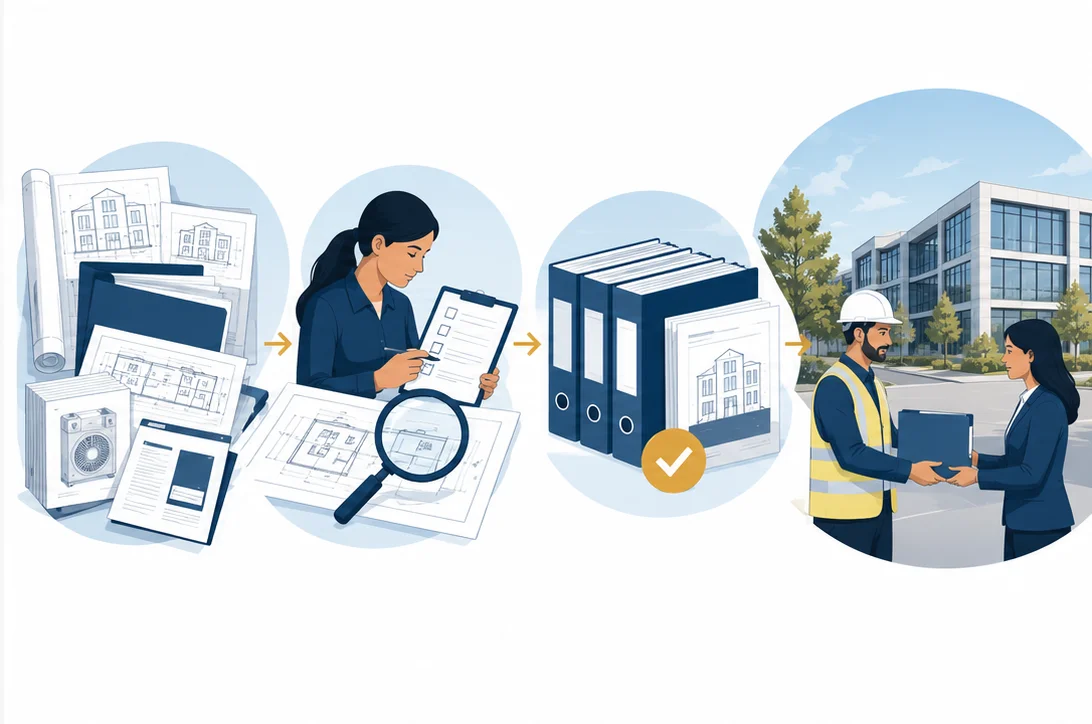
Prepare for handover before completion
- Confirm the final requirements. Check the agreed deliverables and receiving team’s format requirements.
- Collect and review submissions. Track missing records and unresolved comments with the responsible contributors.
- Organise the final package. Index records logically and cross-reference related systems, drawings and equipment.
- Check the issued files. Test links, confirm readability and record any outstanding information and agreed actions.
A controlled project archive and a building handover package serve different purposes. Not every commercial email or interim drawing belongs in an O&M manual. Select the information needed for the agreed deliverable and keep other project records under the appropriate arrangements.
How this supports building manuals
Accurate source information helps a documentation team prepare a usable handover package. Master Manuals organises information supplied by the project team into building manuals and M&E O&M manuals, around the agreed scope.
This preparation role is distinct from providing a document-management software platform or taking responsibility for the technical approval of every project record.
Frequently asked questions
Who is responsible for document control?
Responsibilities depend on the project arrangements. A document controller or project manager may coordinate the register, while the relevant contributors and reviewers remain responsible for their assigned submissions and checks.
Does a document register prove that information is correct?
No. A register tracks information and its status. Technical accuracy still depends on the appropriate checks by the responsible people.
Does every project need specialist software?
The appropriate tools depend on the project’s scale and agreed requirements. Whatever system is used, clear responsibilities, revision control and accessible records remain necessary.
Is the project archive the same as the O&M manual?
No. The archive may contain a much wider range of project records. The O&M manual is selected and organised for the operation and maintenance information required at handover.