
O&M Manual vs Health and Safety File — both are important documents in UK building handover, but they serve different purposes. An O&M Manual helps building owners and facilities managers operate and maintain building systems, while a Health and Safety File provides essential information for planning future construction work safely under CDM 2015.
Two documents that are often confused during this process are the Operation and Maintenance (O&M) Manual and the Health and Safety File. Although they may be prepared and handed over at the same time, they have different purposes and contain different types of information.
Understanding the difference between an O&M Manual and a Health and Safety File helps clients, contractors, principal designers and facilities managers organise project information and avoid missing important handover requirements.
In this guide, we explain what each document is, what it should contain, who is responsible for preparing it and how both documents support a successful building handover in the UK.
What Is an O&M Manual?
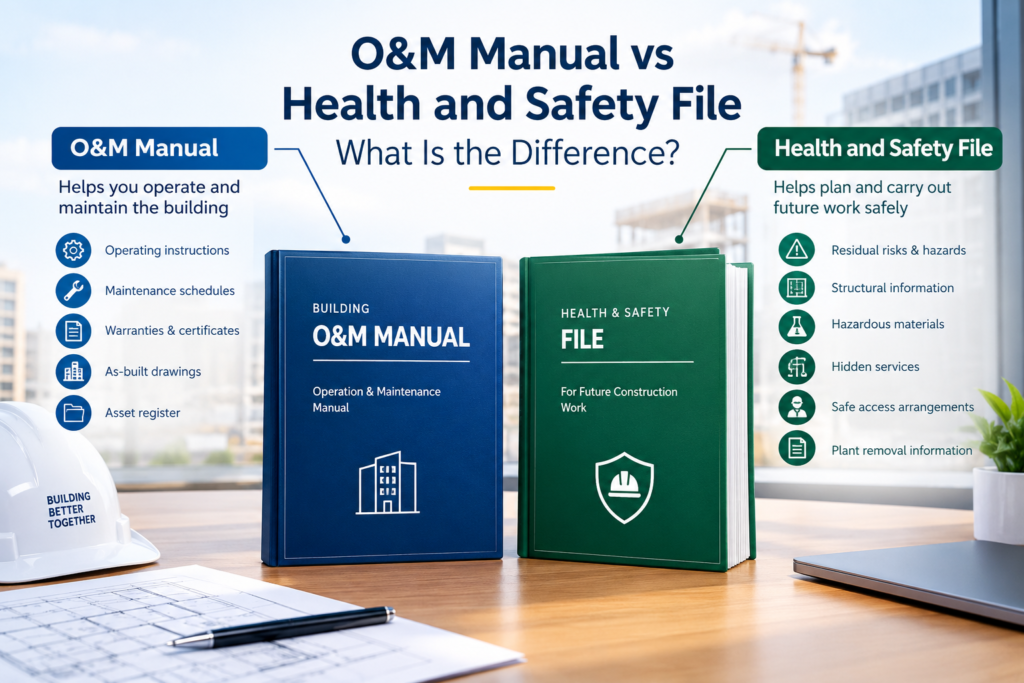
An Operation and Maintenance Manual, commonly known as an O&M Manual, is a collection of information that explains how a completed building and its installed systems should be operated, inspected, serviced and maintained.
It provides building owners, operators and facilities management teams with the technical information they need to manage the building throughout its operational life.
The exact contents depend on the building, installed equipment, client requirements and project specification. Read our guide to O&M Manuals and their purpose for more information.
What Should an O&M Manual Include?
A well-organised O&M Manual may include:
- System descriptions: Information about installed mechanical, electrical, plumbing, heating, ventilation and other building systems.
- Operating instructions: Guidance on operating equipment, controls and building services.
- Maintenance schedules: Recommended servicing intervals, inspection requirements and maintenance procedures.
- Commissioning records and test certificates: Evidence relating to the testing and commissioning of installed systems.
- Manufacturer information: Equipment datasheets, product manuals, technical specifications and supplier details.
- Warranties and guarantees: Relevant warranty documents, conditions and expiry dates.
- As-built drawings: Records showing the completed installation and the locations of relevant systems and equipment.
- Asset registers: Equipment identification, asset references and other information needed for maintenance management.
- Emergency and isolation information: Relevant instructions for safely isolating or managing particular systems, where applicable.
A complete manual should be relevant to the finished building, clearly indexed and easy for the client or facilities management team to use.
For professional support with building documentation, see our Building Manuals service. For the operation and maintenance documentation specifically, explore our O&M manual writing service.
What Is a Health and Safety File?
A Health and Safety File is a project-specific record prepared under the Construction (Design and Management) Regulations 2015, commonly known as CDM 2015.
Its purpose is to provide information that may be needed to plan and carry out future construction work safely. This can include maintenance work involving construction activities, alterations, refurbishment and demolition.
The file focuses on significant risks that remain after the construction work has been completed, together with information that future contractors may need to understand those risks.
Under CDM 2015, a Health and Safety File is required for projects involving more than one contractor. The Principal Designer is responsible for preparing it, with relevant information supplied by the project team. If the Principal Designer’s appointment ends before the project finishes, the Principal Contractor must take on the relevant responsibility for completing the file.
For the official requirements, consult the HSE’s guidance on managing construction projects and the Construction (Design and Management) Regulations 2015.
What Should a Health and Safety File Include?
The information should be proportionate to the project and relevant to the health and safety risks associated with future work. It may include:
- Residual hazards and risks: Significant risks that remain after the design and construction work.
- Structural information: Relevant information about the structure and design assumptions that could affect future work.
- Hazardous materials: Information about hazardous materials that may affect future maintenance, alteration or demolition.
- Hidden services: Information about the location of significant concealed services where relevant to safe future work.
- Safe access arrangements: Relevant information about accessing areas or equipment for maintenance, cleaning or other work.
- Plant and equipment removal: Information that may be needed to remove or dismantle installed equipment safely.
- Relevant as-built information: Drawings and records needed to identify safety-critical features, significant services or residual risks.
The Health and Safety File should not simply become a storage folder for every document produced during the project. Information should be selected because it helps people plan and carry out future work safely.
O&M Manual vs Health and Safety File: Key Differences
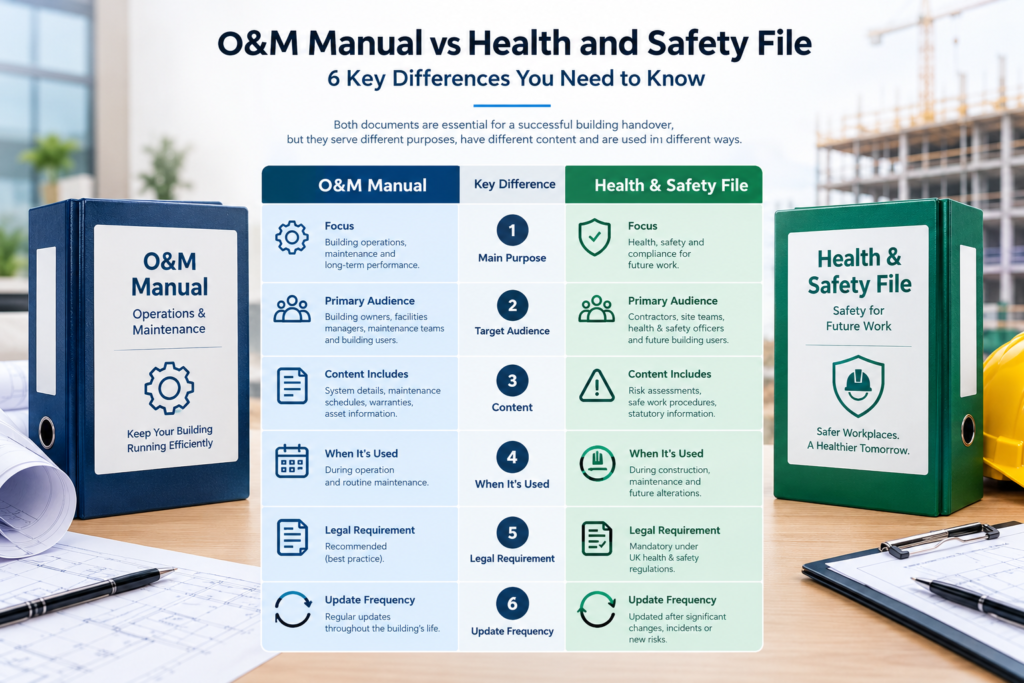
The key differences between an O&M Manual vs Health and Safety File relate to their purpose, contents, intended users and responsibilities under UK project requirements.
| Comparison | O&M Manual | Health and Safety File |
|---|---|---|
| Main purpose | Operate and maintain the building and its systems | Support the safe planning of future work |
| Main users | Building owners, operators and facilities managers | Clients, designers and contractors planning future work |
| Typical contents | Operating instructions, maintenance schedules, certificates and warranties | Residual risks, structural information and relevant hazard details |
| Main requirement | Usually defined by the contract, client specification or project requirements | Required under CDM 2015 where applicable |
| Preparation | Typically coordinated by the contractor or appointed documentation team, using information from suppliers and subcontractors | Prepared under the Principal Designer’s responsibility, with relevant project information from the team |
| Long-term use | Day-to-day building operation and maintenance | Future construction, alteration, maintenance and demolition planning |
The documents can contain some overlapping information, but they should remain clearly identifiable and serve their respective purposes.
Can an O&M Manual and a Health and Safety File Be Combined?
Yes. On some UK projects, the two sets of information are delivered together within a coordinated building handover package.
However, combining them into one package does not mean that they become the same document or that their separate requirements disappear.
A practical approach is to maintain a clear index and distinguish between:
- Information needed to operate and maintain the building.
- Information required to understand and manage risks during future work.
- Information that is relevant to both purposes and can be cross-referenced.
For example, an as-built drawing may help a facilities manager identify installed equipment and also help a contractor understand the location of services before carrying out future work.
Where the same information supports both purposes, it can be cross-referenced rather than unnecessarily duplicated, provided it remains accessible and meets the relevant project requirements.
For more information about organising documentation during handover, read our guide to construction handover and project completion.
Understanding the difference between an O&M Manual vs Health and Safety File helps project teams organise handover documents clearly while ensuring that each document serves its intended purpose.
Who Is Responsible for Preparing These Documents?
Responsibilities should be agreed early in the project because both documents depend on information from several organisations.
O&M Manual Responsibilities
The main contractor commonly coordinates the O&M Manual as part of the contractual handover requirements. Subcontractors, manufacturers, suppliers, designers and commissioning specialists provide the information relevant to their work.
For example, an electrical subcontractor may provide installation certificates, equipment datasheets and operating instructions, while a mechanical contractor may provide maintenance schedules, commissioning information and details of installed plant.
The exact responsibilities should be confirmed in the contract and project documentation.
Health and Safety File Responsibilities
Under CDM 2015, the Principal Designer is responsible for preparing the Health and Safety File and ensuring that relevant information is collected from the project team.
Designers and contractors should provide information about significant residual risks and other matters relevant to future work. If the Principal Designer’s appointment finishes before the project is complete, the Principal Contractor takes over the relevant duties under the regulations.
The client must ensure that the completed file is kept available for future work and updated where necessary. The official CDM 2015 regulations set out the applicable duties.
Common Mistakes to Avoid During Building Handover
Poorly organised documentation can make it harder to manage a building safely and efficiently. The following mistakes are worth avoiding.
1. Treating Both Documents as the Same
A general O&M Manual does not automatically satisfy every Health and Safety File requirement. The relevant safety information must be identified and organised for its intended purpose.
2. Collecting Documents at the Last Minute
Waiting until practical completion to request every certificate, drawing and equipment manual can lead to missing information and delays. Documentation requirements should be agreed and monitored throughout the project.
3. Including Too Much Irrelevant Information
A large document pack is not necessarily a complete or useful one. Information should be accurate, relevant, project-specific and easy to locate.
4. Failing to Check the Final As-Built Information
Drawings and equipment records should reflect the completed installation as far as required by the project specification. Out-of-date information can cause confusion during maintenance or future alterations.
5. Providing Poorly Organised Digital Files
Electronic handover documents should use a clear folder structure, consistent file names and a logical index. The client should be able to find essential information without searching through unrelated files.
6. Forgetting Future Updates
Building systems, equipment and site conditions can change. Relevant records should be reviewed and updated when changes affect the accuracy or usefulness of the documentation.
For additional context, see our article on construction handover and the steps involved in project completion.
How Professional Documentation Supports a Better Handover
A coordinated documentation process helps project teams identify missing information before handover and makes it easier for the client to understand what has been delivered.
Professional building documentation services can support the collation and organisation of O&M Manuals, Health and Safety Files, asset registers, as-built drawings, test certificates, warranties and other required handover information.
The precise scope should always reflect the contract, client requirements and applicable regulations. A clear document structure also helps building owners and facilities managers locate the information they need after the project team has moved on.
Explore our Building Manuals service to learn more about the documentation support available for UK projects.
Frequently Asked Questions
Is an O&M Manual a legal requirement in the UK?
O&M Manuals are commonly required by building contracts, employer’s requirements or project specifications. Their precise requirements depend on the project. They should not be confused with the separate statutory requirements that apply to a Health and Safety File under CDM 2015.
Is a Health and Safety File compulsory on every construction project?
No. Under CDM 2015, a Health and Safety File is required where more than one contractor is involved in the project. The project team should establish the applicable duties and responsibilities for the specific project. See the HSE’s construction guidance.
Can the Health and Safety File be included in an O&M Manual?
Yes, the information may be delivered together in a combined handover package. However, the Health and Safety File information must remain clearly identifiable, suitable for its purpose and compliant with applicable requirements.
Who prepares the Health and Safety File?
The Principal Designer is responsible for preparing the file under CDM 2015. If their appointment ends before the project finishes, the Principal Contractor takes over the relevant duties. The project team must provide the information needed to complete it.
What is the difference between a building manual and an O&M Manual?
A building manual may be a broader handover package covering several types of building information. An O&M Manual specifically focuses on operating and maintaining the building’s systems and equipment. The precise meaning of a building manual depends on the project specification.
Conclusion
An O&M Manual and a Health and Safety File are both important parts of building handover, but they serve different purposes.
The O&M Manual provides practical information for operating, inspecting and maintaining the completed building. The Health and Safety File records relevant information needed to plan and carry out future work safely under CDM 2015.
Knowing the difference between an O&M Manual vs Health and Safety File helps ensure that building handover documentation is organised to meet the needs of building operators and future project teams.
When both are planned, prepared and organised properly, clients receive clearer handover information and facilities teams can manage the building more effectively.
Need support with your building handover documentation? The Master Manuals can help with the preparation and organisation of O&M Manuals and associated building handover documentation to suit your project requirements. Visit our Building Manuals service page or contact our team to discuss your project and documentation needs.