
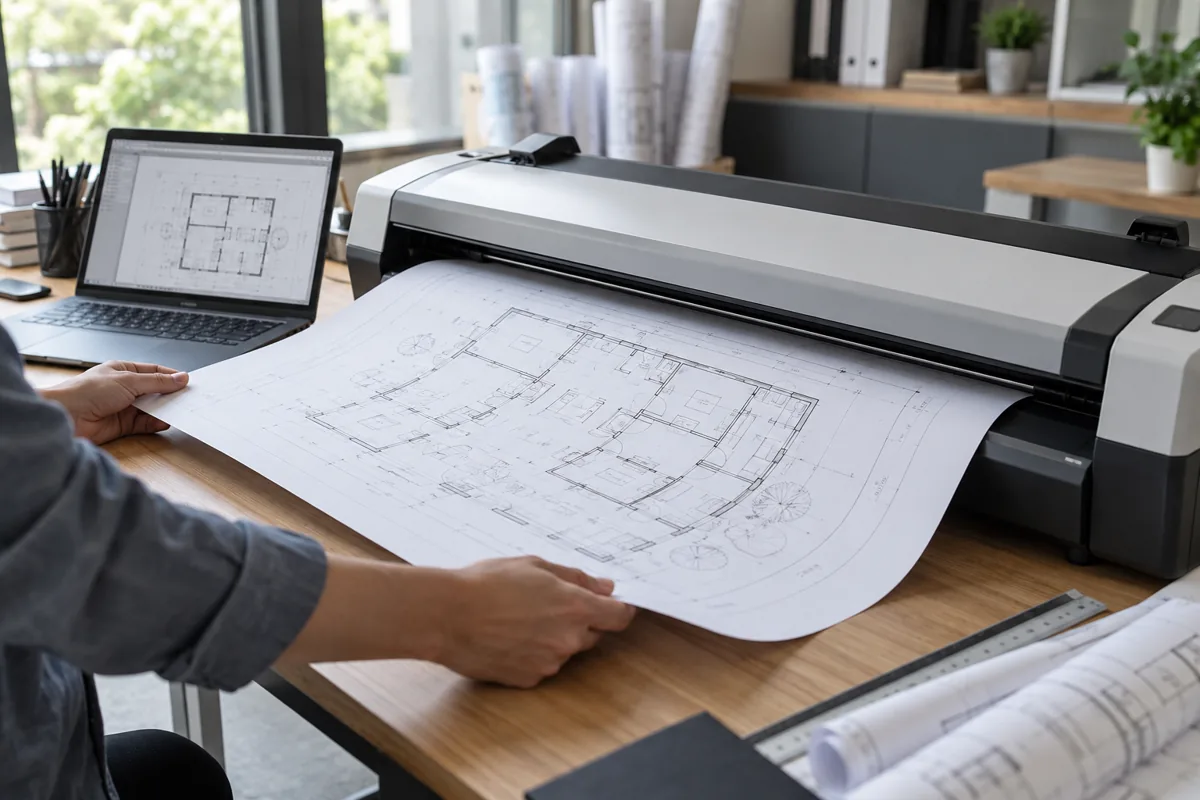
Construction document scanning converts paper drawings and project records into digital images. To make those files useful, the team also needs an agreed scope, suitable capture quality, clear file identification and a plan for storing the results.
Scanning is one step in organising an archive. It does not verify that an old drawing describes the installed works, correct conflicting revisions or turn every paper record into an editable technical file.
Review the paper records before scanning
Identify the documents to be captured, their condition and the required output. Construction archives may include oversized drawings, faded copies, folded plans, certificates and mixed-size correspondence.
Agree how originals will be identified, transported and returned where a scanning provider is appointed. Fragile or valuable documents may require specialist handling. Do not assume that every item is suitable for the same equipment or capture process.
Distinguish the possible outputs
| Output | What it provides |
|---|---|
| Scanned image | A digital image of the original page or drawing. |
| Searchable document | A scan with recognised text added through OCR, where suitable. Recognition needs checking. |
| Editable CAD drawing | A different deliverable requiring an appropriate conversion or redrawing process; a scan alone is not equivalent. |
Optical character recognition (OCR) may help users search printed text, but recognition can be unreliable with faint pages, handwriting, symbols or complex layouts. The visible scan and the recognised text should not be assumed to have the same accuracy.
Agree and review a representative sample
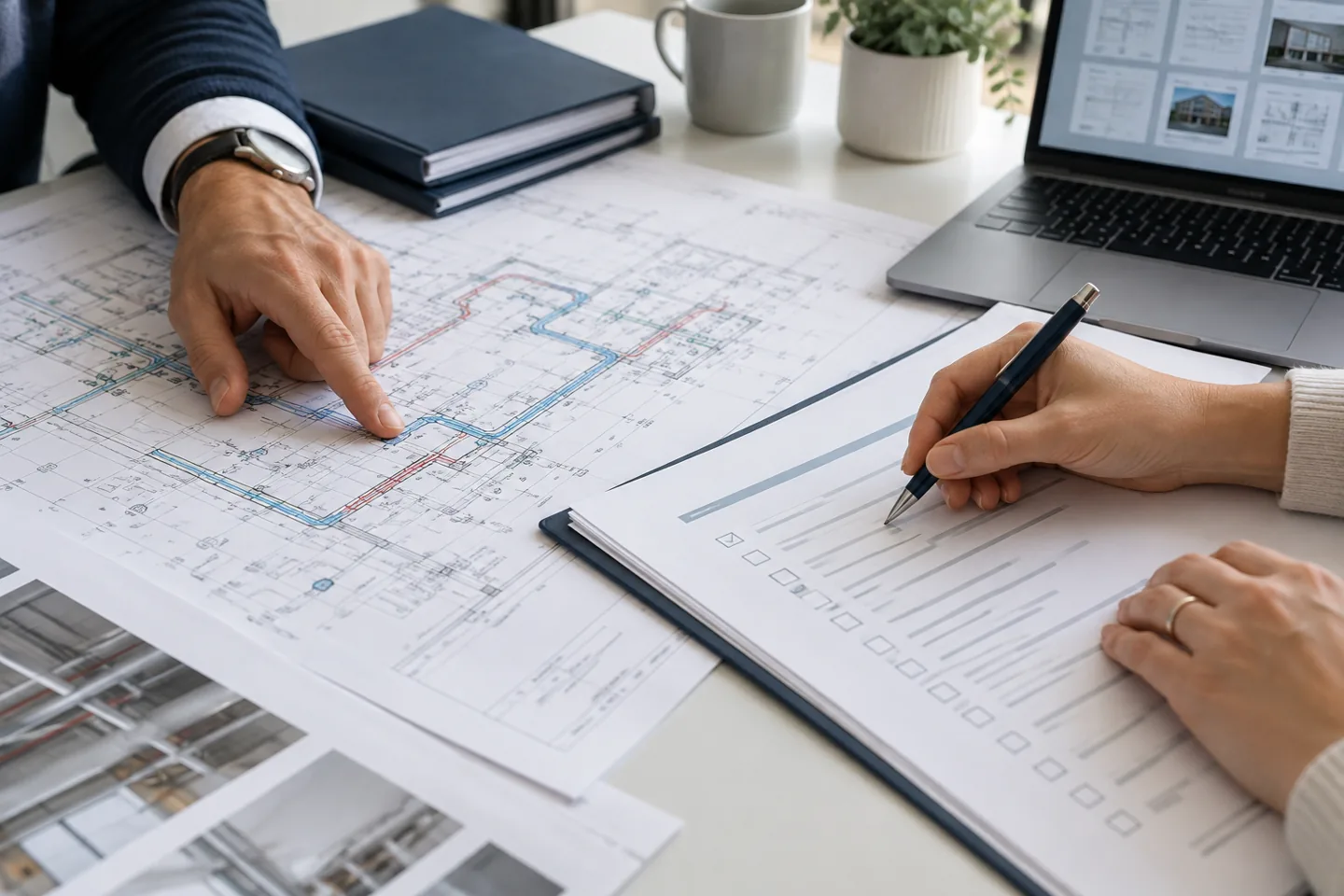
Ask for sample outputs covering the actual range of records, including any oversized or difficult originals. Choose capture settings for the intended use rather than applying a single resolution or file format without checking the results.
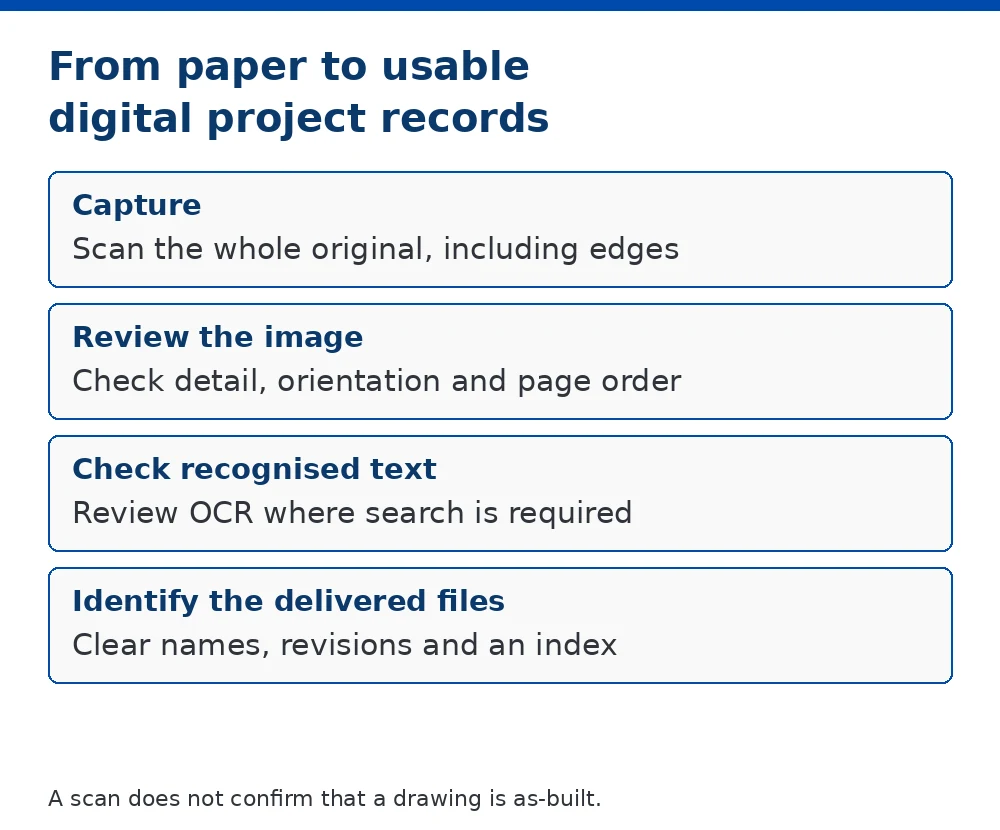
- Can the whole page be seen, including edges, notes and drawing references?
- Are small labels, symbols and fine linework legible?
- Are orientation, colour and contrast suitable for interpreting the source?
- Are pages complete and in the correct order?
- Do the file names and index identify the source documents?
- If OCR is required, are sample search results and recognised text usable?
The National Archives’ digitisation guidance discusses preserving content and context and checking sample scans and OCR output. It provides useful general principles; it is not a project-specific construction scanning specification.
Name the files so people can find them
Use an agreed convention based on available identifiers, such as project, document number, title and revision. Record uncertain or missing information for review rather than inventing a reference or assuming that the newest-looking copy is approved.
Keep the relationship between the original and the digital file clear. An index can explain document types, issue information and source locations without relying on long or ambiguous file names.
Store and retain the records under agreed arrangements
Decide where files will be held, who can access them and how backups and future retrieval will be managed. Test the delivered package before closing the scanning work.
Scanning does not automatically make destruction of an original appropriate. Any retention or disposal decision should follow the organisation’s applicable requirements and agreed records policy, with the responsible person making that decision.
Connect scanned records to the handover information
Useful scans may form part of a wider documentation package, but they still need to be relevant, correctly identified and reviewed by the responsible contributors. Digitising an old record does not establish that it is current or complete.
Master Manuals prepares building manuals using supplied project information. This guide explains how scanning can support records preparation; it does not advertise a specialist scanning service. The inclusion and organisation of supplied digital records should be agreed within the project scope.
Common questions
Can large construction drawings be scanned?
Suitable large-format equipment can capture oversized drawings. The provider should assess the size, condition and detail of the originals and agree the required results.
Does scanning create an as-built drawing?
No. It creates a copy of the supplied document. Whether that document accurately records the completed works requires separate confirmation.
Should the original files be checked individually?
Agree a quality-assurance process appropriate to the records and intended use. A successful sample does not remove the need to check the delivered collection for omissions and capture problems.